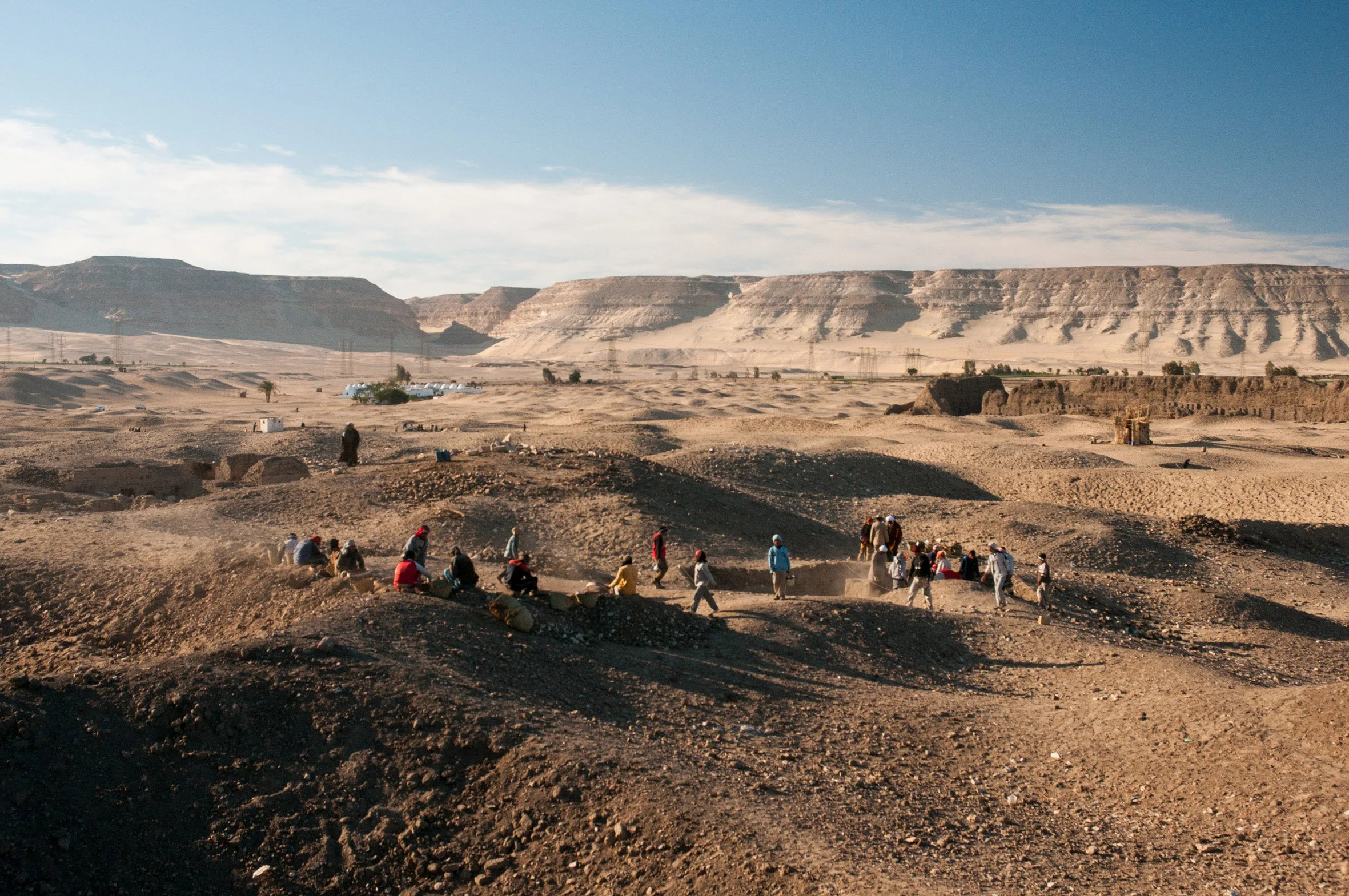
For more than three thousand years, Abydos in southern Egypt mattered to the people who lived, ruled, and worshipped there. It served as the burial ground for Egypt's first kings and remained a key religious center, particularly associated with Osiris, the god of the underworld. Pilgrims came for centuries to honor him at an annual festival, and Seti I built one of the finest temples Egypt ever produced there, out of his devotion to the god

For Dr. Bestock, Abydos is the place she has wanted to work since she was an undergraduate, though her fascination with Egypt began well before that. In high school she was already captivated by the Early Dynastic period, the centuries when Egypt was first becoming a unified state, and she special-ordered a book on archaic Egypt to learn more. To her, it was an inflection point, the moment when the kingship, the capital, and the burial traditions that defined Egypt for the next three thousand years were taking shape, and she soon learned that only a handful of sites speak to that moment. Abydos is the most important of them. A study-abroad year in Cairo, with a field trip to the site, confirmed her interest, and she later went to NYU for graduate school specifically to work with David O’Connor, the professor who ran the excavations at Abydos. When the project needed a new director in 2024, she was ready to take it on.
Digging where every layer matters
Abydos covers roughly ten square kilometers along the edge of the Western Desert, with settlements, cemeteries, and temples spread across it. People have lived there for more than five thousand years. The earliest graves are prehistoric, dating to around 4000-3500 BCE, and the site reached real prominence in the late Predynastic and Early Dynastic periods, between about 3150 and 2650 BCE. Most Early Dynastic kings were buried in Umm el-Qaab, also known as “mother of pots.” The cult of Osiris then flourished from the Middle Kingdom through the Roman period, so the site kept accumulating history long after its first kings were gone.
That depth creates a real challenge for anyone planning an excavation, because digging into one period means disturbing another. Dr. Bestock’s approach is to let research questions about early Abydos set the direction. Her joint team from Brown University and the Institute of Fine Arts at NYU is studying the funerary enclosures associated with the royal tombs, asking when and why they were destroyed and how to conserve what remains. The answers help determine where the trenches go. The later layers deserve respect and care, and she describes the tension between the two as a constant part of the work. Dr. Bestock thinks of archaeology at Abydos as working within a world that earlier people inherited and passed on, in a physical space that has always been there and has always meant something to those who came to it.
Digitizing thirty years of records
Alongside the fieldwork, Dr. Bestock leads a project with a different focus: digitizing thirty years of records from excavations at the Institute of Fine Arts, New York University. Other than the obvious necessity to publish this backlog, Dr. Bestock believes archaeologists produce data for the world, which means researchers should have access to it even before the final publications are finished, not years afterward. A team of students and volunteers work through the backlog chronologically and is currently inputting records from the 2004 - 2005 season.
The archive is already rich. It holds more than 25,000 photographs, along with notebooks, reports, and fieldnotes, all password-protected; however, Dr. Bestock is happy to give logins to researchers whose work depends on the material, and students especially benefit.
The work itself is slow. Seasons vary in how much detail they recorded, and the older ones have lower-quality photographs. Trench numbers were reused across seasons, which causes issues in a digital system, meaning each one has to be reindexed. Additionally, the notes tend to be narrative rather than structured, and the process of turning prose into data is painstaking. However, Dr. Bestock is shifting the focus of the digital archive toward illustrating the archaeology itself, moving beyond the original recordings, which showcased field staff engagement through candid photographs. Digitization is only the first step; study of the resulting record and moving it towards publication takes even more time, but this critical work, too, is picking up steam.
The tool that made it possible

The platform behind the project is Kiosk, which Dr. Bestock has been developing with Lutz Klein over the past ten years, beginning with an excavation in Sudan that had no internet access and therefore no way to digitize records. Brown has since supported the work with a full-time digital software developer position in archaeology, housed in the Center for Digital Scholarship at the Rockefeller Library. Kiosk now handles field recording for colleagues on several projects, each of which is customized for its own workflows and numbering systems, and it also supports projects from outside Brown. It wasn’t built for archives at first, but it has expanded to handle the Abydos archive and now holds the data and manages the notebooks themselves. Notebooks are scanned and managed in Kiosk before their contents are entered, and everything runs online.
Dr. Bestock has also brought AI into the transcription process, with set limits. It reads handwriting quickly, but it lacks accuracy in recording details like locus numbers, which identify specific deposits and absolutely cannot be wrong. She sees it as a helper, never a replacement for human judgment. While it is faster to have a student check an AI transcription than to start from scratch, it is an arrangement that she worries will lead to decreased engagement among the students. Risking turning them into machines rather than encouraging them to actively interact with the material as scholars. This is an ongoing process, and finding the right balance will be a constant endeavour.
A project built on people
The Abydos project brings together Brown, NYU, UC Irvine, and volunteers. For Dr. Bestock, the goal goes beyond data that is delivered quickly. She wants to train the next generation, and having two universities involved exposes students to different methods and invests them as both people and scholars. That commitment reaches into the classroom as well. In Spring 2026, students in a Brown course on Middle Egyptian were given the chance to translate a private stela from Abydos, with their work credited in the 1997 season report.
Students who want to get involved in the project have a clear way in. Transcription will continue for about three more years, and the project can absorb a nearly unlimited number of volunteers. Part of the work is led from UC Irvine by a former Brown student, now a professor, Luiza Silva, who has trained her own students in digitization. Anyone interested can simply reach out to Dr. Bestock.
Back to the field
The digital work is only half of the story. This December, the team returns to Abydos for a season that combines excavation with architectural conservation. There are two standing ancient mudbrick monuments within the project’s area of work, one an Early Dynastic royal enclosure and one a Ptolemaic wall, both facing long-standing and new threats. No previous work had been undertaken at the Ptolemaic wall until October of this year, when the first study and conservation intervention was initiated. The excavation itself continues in an Early Dynastic enclosure, and two graduate students from Brown and NYU will be part of the team.